
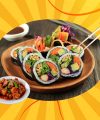


Kdramas Never Fail To Leave Us Hungry: Top 15 Eating Moments That Are Iconic!

Listen Up Guys! I was just making my monthly stash of kimchi in the kitchen. My mom walked up to me and exclaimed, ‘Look at you, you’ve become a complete Korean! ‘
We then started having a kitchen discussion, reminiscing about how I started incorporating Korean foods into my kitchen. So, I wanted to share this with you guys as well!
I remember that I was so driven by the food practices I saw in all the dramas I binge-watched during the pandemic.
Moreover, I had free time on my hands as well, so I tried and tested some of the recipes I really liked watching on the screen, and boom! I was so impressed with myself, I swear!
Since then, certain dishes have become staples for me. Now, the essence of Korean cuisine has become my regular, and I have been enjoying this partnership a lot, thanks to the best KDrama food scene!
The Best KDrama Food Scene: A Hard Find(?)

Food is a celebratory element in all cultures, especially Asian cultures. We consider this element, which brings us together and creates bonding.
This is no exception in Korean dramas. Here, food is presented as a lot of things—as a prime metaphor, as a catalyst of love, or just an entity that brings communities together,
Look, if I am being completely honest with myself, I would say that the ‘best’ KDrama food scene varies from viewer to viewer. Although for me, it is those scenes that influenced me to try out these Korean dishes.
So, I would take you on a little trip to showcase all my best KDrama food scene and the food I saw there, which is something I eat a lot, if not regularly.
When Life Gives You Tangerines
Not only have I cried mercilessly while watching this drama, but I have also carried the tears to my kitchen and made myself a bowl of fresh rice and peas.
In this drama, there is a scene where the male protagonist shares his peas with his daughter, and this shows the love amidst the growing vulnerability around them.
Well, to avoid crying all over again, let me get back to rice and peas. Meme Gohan, Green Pea Rice, is a dish that is often served in Korea during springtime when green peas are in season.
It’s a pretty grounding dish, just two scoops of rice and a handful of peas mixed together. I have this regularly whenever I have fresh peas at home.
Listen up guys, though this has no separate taste whatsoever, but I still have it during every meal, well, just for the vibes!
Vincenzo
One of my favorite dramas is this drama, which is the sole reason that I might not have salt or pepper at home, but I will always have tteokbokki. It definitely has some of the best KDrama food scene.
Vincenzo has showcased this particular Korean delicacy like no other. There is a character who had an eatery business, and everyone who went to eat there always used to order a plate of ttoekbokki.
When I first saw a character eat ttoekbokki there, I found it so delectable that I ordered rice cakes at home and went on to make a plate full of steamy, spicy ttoekbokki.
But instead, I made myself a plate full of happiness!
It’s Okay to Not Be Okay
This drama introduced Mayak or quail eggs to my daily diet. Though I knew about the benefits of having quail eggs before, I started having them after I watched this drama.
In this drama, the female lead, the ethereal goddess Soo Yea-ji, ate these eggs every time. Well, if I cannot look like her, at least I can eat like her!
Jokes apart, this drama uses food as a very serious underlying metaphor, which brings the characters together in many scenes.
More than the food itself, the concept of mealtime has been portrayed as a very holistic one, where all the different characters share a meal despite their differences.
Weightlifting Fairy Kim Bok-Joo
All the foodies, pay attention! We will be talking about the mother of all foodies, Ms Kim. I want an appetite like hers to satiate all my hunger.
Even though the fried chicken scene is the famous one, where Kim and her friends eat bowls full of fried chicken and keep asking for more, the best gift from this drama to me is the Hotpot Scene.
In this scene, Kim, along with her friends and acquaintances, goes to a Hotpot night, where she explains the rules of enjoying a Korean Hotpot the authentic way.
This scene is also a breakdown of the hotpot scene for the non-Korean audience, which bridges the gap between the cultures and works as an on-screen YouTube video. This is a lovely way of spreading awareness about the cultural nuances.
This drama has numerous food scenes, which I absolutely loved. Another scene that has inspired my weekend breakfast scenes is where Kim Bok-joo is sitting with her friends, having bagels with cream cheese. LOVE!
Mr. Queen
In this drama, there is a scene where the protagonist showcases the concept of Ramyeon, or ramen, to the Joseon court,
After that scene ended, I had to mop the whole floor, as it was completely covered in my drool. The scene showcases the modern-day chef’s precise preparation of the ramen.
Watching the whole scene was like a visual ASMR, the chef’s meticulous use of the ramen ingredients, such as noodles, vegetables, along with a rich creamy broth.
The incorporation of today’s cooking techniques made the dish look even more visually appealing and delectable.
This scene also portrays a sharp contrast between traditional and modern-day cooking techniques. Moreover, it showcases a great breakthrough in culture in the Joseon era.
Hospital Playlist
The way this drama has influenced the essence of Jjangmeyon on me, no mukbang video ever could. Forever grateful!
Every Korean drama and food lover will be familiar with the concept of Jjangmyeon. It is prepared with a Korean black bean paste, which makes it a spicier version of Chinese noodles.
This one scene, where two characters were relishing this masterpiece of a dish, and one of them stirs another’s bowl very lovingly.
This scene made me so hungry; I made Jjangmyeong at home. I ordered the black bean paste, along with someone to stir my bowl lovingly. Well, just the black bean paste came. Ha!
Itaewon Class
First of all, I had a great time binge-watching Itaewon Class. The storyline was extremely addictive, and Park Seo-joon’s character and acting were both worth it.
The food part is a bonus. Itaewon Class has introduced two of my favorite and easiest-to-make recipes ever.
In an episode, we see a character ordering a stir-fried pork with bean sprouts and a tofu stew. He enjoys this combo with a Soju.
Both these recipes are extremely convenient, as it is both easy to cook and incredibly tasty. It has been my jam since then, and I am never going back.
My Secret Romance
Although I have eaten abalone porridge before, I watched the characters eat it in the drama; I think this drama adds an emotional touch to the dish.
In My Secret Romance, abalone porridge appears in the concluding episode as an important emotional symbol.
The situation arises as Jin Wook goes to see his mother, who cooks the meal for him.
Following their discussion, Jin Wook relishes this porridge, which represents warmth and family bonds. This moment stands in stark contrast to the previous scenes.
A notable example can be the leech soup in Episode 6, which facilitates a playful exchange between Jin Wook and Yoo Mi, emphasizing the changing dynamics of their relationship.
How Can Drama Influence the Food Culture?

Korean dramas have played an immensely important role in promoting Korean culture across their viewers, especially the culture of food.
Due to its aesthetic appeal, as well as the mukbang-ish attributes present, the food shown in the dramas has influenced every single one of its audiences.
This is an example of how the entertainment industry asserts its soft power over different cultures.
The Korean dramas have massively influenced the lives of their audience; almost 94.2% asserted that the food scenes have encouraged their intake of Korean cuisine.
The Global Impact
In the year 2023, the food exports of South Korea have witnessed an upsurge in the demand for Korean ramen, rice cakes, Korean beverages, and kimchi. The record goes as high as $8.27 billion.
The most notable Korean instant noodles or ramen brand, Shin Ramyeon, has contributed to this case with exports worth $1.36 billion in the year 2024 itself.
Shin Ramyeon has achieved a total of $883 million in sales just in the year 2023; approximately 60% of it came from the international markets. This brand plans to reach $1.5 billion in U.S sales by 2030.
The exports of processed foods like frozen kimbap, instant rice, and tteokbokki saw a 41.9% year-on-year increase, reaching $250 million in 2024.
In the United Kingdom, there is a 71% upsurge in the sales of Gochujang and a 974% upsurge in the Korean chicken recipe searches.
In India, Korean instant noodles, such as the Samyang noodles or the Shin Ramyeon, have witnessed a volume growth in the year 2020, all credit goes to the influence of K-pop and K-dramas.
This was the list of the best k drama food scenes, which introduced me to the world of such amazing flavors. What do you have to add to it? Share in the comments below!
ADDITIONAL READING:
Share This Article:


RELATED POST